Mini-Adventure “Night in the Park” (Legal Version): How to Plan a Short Evening Hike Close to Home
A “night in the park” mini-adventure is a simple, legal way to get the feeling of a real trip without travelling far. You’re not camping illegally or staying overnight in protected areas — you’re planning a 2–4 hour evening walk with a clear route, safe timing, and a small kit that keeps you comfortable. In 2025, this kind of micro-adventure is popular because it fits busy schedules, costs almost nothing, and still gives you that reset you usually get from a proper day out.
Plan a 2–4 Hour Route That Works After Dark
Start with a realistic time window. For most people, the easiest format is: arrive before dusk, walk during early dark hours, then leave while public transport or parking is still straightforward. In the UK, sunset times change dramatically through the year, so check the exact sunset for your location and build your plan around it. A good rule is to begin your walk about 30–60 minutes before sunset, so you can adjust your pace and get used to the drop in light.
Choose a route that stays familiar and predictable. For an evening hike close to home, circular routes are usually better than out-and-back because you’re less likely to turn around too late and feel rushed. Aim for 3–6 km depending on fitness and terrain. Flat park loops, riverside paths, canal towpaths, and maintained woodland trails are typically the easiest options for a first attempt. Avoid remote moorland, cliffs, or complex trail networks unless you already know them well.
Write the route down in a way you can follow offline. Use a simple note: starting point, key turns, and one or two obvious landmarks. If you prefer an app, download an offline map area in advance. Your goal is not “exploration” — it’s a controlled mini-adventure where you always know where the next safe exit is. Build in one “bail-out” point halfway (a café, car park, main road, or bus stop) so you have a clear alternative if weather changes or anyone gets tired.
Quick Route Template You Can Copy
Here’s a practical template that works in most towns and cities. Pick a well-lit park with a perimeter path, add a quieter section that still has clear signage, then finish with an easy return. Example structure: 10–15 minutes warm-up walk from your start point → 60–90 minutes steady loop → 15–20 minutes pause for a hot drink/snack → 30–60 minutes return route that stays on the simplest path.
Keep the “quiet section” short and optional. Many people overestimate how comfortable they’ll feel in a dark wooded area the first time. Instead, plan to try a 10–20 minute stretch and then decide whether to extend it. If the park has multiple loops, start with the easiest one and only add distance if everything feels calm and safe.
End at a place that makes leaving easy. If you drive, aim to finish near your car without walking long unlit streets. If you use public transport, time it so you’re not waiting alone at a stop late at night. Even a small detail like finishing near an open petrol station can make the whole experience feel more relaxed.
Safety Rules That Keep It Legal and Low-Risk
The “legal version” matters: you’re not pitching a tent, lighting fires, or staying past permitted hours in restricted spaces. In the UK, many parks close at a set time, and some are gated. Check the park’s signs or local council information before you go. If there’s any doubt, choose a park that clearly stays open late or use a public footpath route that is accessible at night. Staying within the rules protects you and avoids awkward situations with security or police patrols.
Safety in the dark is mostly about predictability. Tell one person where you’re going and when you’ll be back — even if it feels a bit formal for a short walk. Keep your phone charged, take a small power bank, and carry a torch even if you plan to rely on streetlights. Head torches are ideal because they free your hands, but a simple handheld torch works fine if it’s bright enough and you’re comfortable using it.
Manage the big risks: slips, poor visibility, and getting disoriented. Wear shoes with a decent grip (wet leaves and mud are the most common issue). Avoid headphones in both ears — you need to hear cyclists, dogs, and other people. If you’re alone, stay on paths that have regular passers-by but aren’t crowded. If something feels wrong, trust that instinct and leave early. A mini-adventure is successful if it ends calmly, not if it pushes you into discomfort.
How to Choose a Place With Lighting and Minimal Hazards
Look for three things: reliable lighting, clear paths, and predictable surroundings. Good candidates include parks with lamp-lit main routes, large urban green spaces near residential areas, riverside promenades with handrails, and canal towpaths that are maintained and commonly used in the evening. Avoid places with sudden drops, unprotected water edges, or complex intersections where you could easily take the wrong turn.
Check the terrain in daylight first if you’ve never walked there. A quick 20-minute visit earlier in the day can help you spot hazards like muddy sections, steep steps, or poorly lit corners. In 2025, many people use map apps and street-view style imagery to preview access points and entrances, which is especially useful if a park has multiple gates and not all are open late.
Reduce social risk by choosing areas with “normal evening activity.” A safe park at night isn’t necessarily empty — it’s often the one where you see dog walkers, runners, and people heading home. If a location feels isolated or has a reputation for late-night problems, pick another option. This is meant to be a refreshing short hike, not a test of nerves.
What to Bring: A Simple Checklist That Actually Helps
You don’t need a full hiking loadout for 2–4 hours, but a few items make a big difference after dark. Think in layers: temperature drops quickly in the evening, even in mild seasons. A light insulating layer (fleece or thin puffer) and a windproof outer layer usually cover most situations. In wetter months, a compact waterproof jacket is worth it because a short shower feels much longer when it’s dark and you’re far from home.
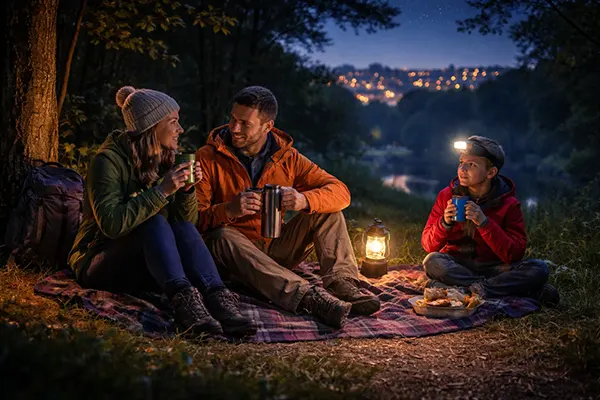
Carry small, practical fuel. A hot drink in a flask is one of the best morale boosters on a night walk. Add easy snacks that don’t require preparation: bananas, flapjacks, nuts, or a sandwich. Keep everything in a small backpack so your hands are free. If you’re with kids, include one “comfort item” (a small blanket for a bench break, or a familiar snack) because it helps avoid the tired-and-cold moment that can spoil the last part of the walk.
Bring tools for the most likely problems. A torch or head torch is non-negotiable, and a spare battery or power bank is sensible. A small first-aid kit is useful even if it’s just plasters, blister tape, and antiseptic wipes. Add a reflective band or light if you’ll cross roads or shared cycle paths — it’s a simple way to stay visible without making the walk feel like a serious expedition.
Three Quick Packing Lists: Solo, Couple, Family
Solo: phone + power bank, torch/head torch, water (500 ml–1 l), warm layer, waterproof shell if needed, small snack, ID and a bank card, keys, and a simple offline route note. If you tend to feel uneasy alone, choose a busier route and consider sharing live location with a trusted person for the duration of the walk.
Couple: one shared power bank, two torches (or one head torch and one handheld), a flask to share, a small snack bundle, and a compact sit-mat or small blanket for a bench stop. Agree on the “turn back time” before you start so neither person feels pressured to push on if the mood changes.
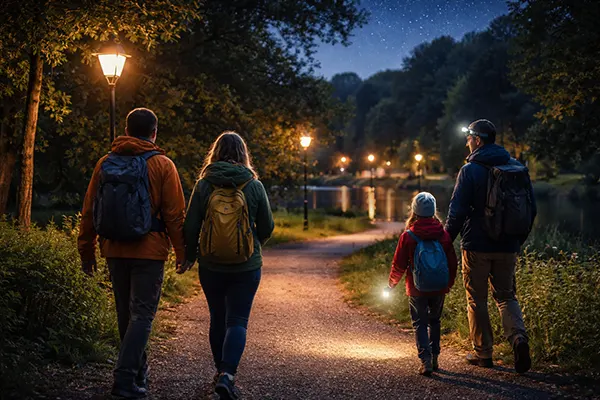
Family: torches for adults and at least one for a child, warm spare layers for kids, snacks that won’t melt or crumble too much, wipes, a small first-aid kit, and a plan for an early exit. Keep the route shorter than you think — children usually enjoy the “night” feeling even on a 60–90 minute loop, especially if you include a fun pause like looking for constellations or listening for owls.
Leave No Trace (Plain-English Version)
Leave No Trace is simply the idea that the park should look the same after you leave as it did before you arrived. That means: take all litter home, including fruit peels, tissues, and bottle caps. If you bring snacks, pack them in a way that doesn’t create loose wrappers that can blow away in the wind.
Stay on paths where possible, especially in winter and early spring when the ground is easily damaged. Cutting across grass or muddy areas can create new “desire lines” that widen over time. At night, it’s also safer to stick to clear routes rather than stepping into dark patches where you can’t see holes, roots, or wet ground.
Respect wildlife and other people. Keep noise low, don’t shine torches directly into animals’ eyes, and give dogs on leads plenty of space. If you stop for a break, choose a bench or a hard surface rather than trampling sensitive areas. The goal is a calm evening hike that doesn’t disturb the place or the people sharing it.