How to Organise a Home Quiz: Questions, Timing and Prizes
A home quiz is one of the easiest ways to get people laughing and talking without needing much space or equipment. The difference between a “nice idea” and a genuinely good night is usually planning: the right mix of question types, tight timekeeping, and prizes that feel light-hearted rather than awkward.
Plan the structure: rounds, difficulty, and scoring rules
Start by deciding the shape of the evening. For most living-room quizzes, 6–8 rounds works well, with 6–10 questions per round (roughly 50–70 questions total). That’s long enough to feel substantial, but short enough to avoid fatigue. A simple, reliable mix is: General Knowledge, Themed Round (films, travel, football, food), Picture Round, Music/Audio, “True or False”, and a final mixed round.
Keep difficulty balanced on purpose. A practical approach is the 3–3–2 rule per round: three easier questions most teams can get, three medium questions that need thinking, and two tougher ones that create separation on the scoreboard. If you have mixed ages or different knowledge levels, write questions so everyone has a way in: for example, a history question that rewards reasoning even if someone doesn’t know the exact date.
Lock in scoring before you begin and stick to it. One point per correct answer is the cleanest option. Add a tie-break question prepared in advance (e.g., “Closest wins: how many…?”) so you do not have to improvise under pressure. Decide whether spelling matters, whether near-misses count, and how you’ll handle disputes—ideally, you only accept the written answer, not a post-hoc argument.
Build question sets that feel fair, specific, and “home friendly”
Good home-quiz questions are concrete and unambiguous. Avoid anything that depends on obscure wording or a single niche reference. If you want variety without confusion, rotate formats: multiple choice (great for harder topics), short answer (best for straightforward facts), and “two-part” questions (e.g., name + place) that can award partial points if you choose.
Write each question with a quick “fairness check”: could a reasonable person interpret it in a different way? If yes, rewrite it. Also check that your answer has one clear source of truth (release year, official name, recognised statistic). This matters most for pop culture and sport, where remakes, sequels, and overlapping titles are common.
To keep things current for 2026, include at least one round that can be updated quickly right before the quiz: recent film awards, big sporting moments, major headlines, or trending music. If you’re not confident about a detail, drop it—one shaky question can derail the mood far more than people expect.
Timing that keeps energy up: a simple schedule that works
For an in-person home quiz, aim for 75–110 minutes of game time, plus short breaks. A practical schedule is: 10 minutes to explain rules and form teams, then rounds that take 10–12 minutes each (including answering time), with a 5–8 minute break halfway through. If you have snacks, place them at a break rather than letting food interrupt every round.
Use a timer and be consistent. Most questions work well with 30–45 seconds; harder ones can take 60–90 seconds, but only if the whole round is designed that way. Announce “15 seconds left” and “pens down” clearly. If you allow teams to keep talking while you read answers, you’ll lose control of pace, so build in a clean rhythm: ask → time → stop → mark.
If you’re hosting remotely, timing needs more buffer. Video calls add delays, people talk over each other, and answer submission can be messy. Keep remote rounds shorter (6–8 questions), and build in an extra minute for sending answers. For remote marking, a shared document or simple form can be smoother than reading answers aloud one by one.
Simple quiz tools (optional) that reduce admin
If you want automatic timing and a live leaderboard, a join-code quiz tool can handle the mechanics for you. This is useful when you have a large group or when you want to keep the pace brisk without manually tracking every point.
For a quieter “answer sheet” style, a form-based approach works well: teams submit answers each round, and you mark centrally. It is especially practical for remote quizzes because everyone submits in the same format, reducing confusion and repeated questions.
If you prefer a presenter-led feel, show the questions on a screen and collect answers on paper or via a shared document. The key is consistency: one method for submitting answers, one method for marking, and one clear rule for when teams must stop writing.
Prizes and hosting details: keep it fun, not awkward
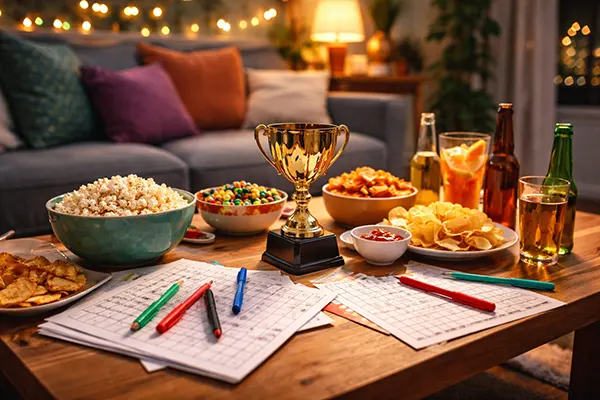
Home-quiz prizes work best when they match the tone of the group. For adults, think “useful but light”: a small treat, a coffee voucher, a book, or a novelty trophy that returns next time. For families, swap in board-game snacks, cinema vouchers, or a “choose the next film” token. The goal is to avoid anything too personal or expensive, because that can make winning uncomfortable and losing feel worse.
Set a simple prize budget rule: either one main prize (the cleanest option) or one main prize plus a small “last place” prize to keep things friendly. If you do a last-place prize, make it genuinely nice (e.g., sweets) rather than a joke item. Humour can work, but it should never embarrass someone.
Host like a referee, not a performer. Speak clearly, repeat each question once, and avoid giving hints through tone. When someone challenges an answer, stay calm and use your pre-agreed rule: either “host decides” or “we only accept what’s written”. People forgive strictness; they rarely forgive inconsistency.
Prize ideas and mini-awards that add energy without extra cost
Mini-awards can lift the room without stretching the budget. Examples: “Best team name”, “Closest guess” (for one estimation question), or “Comeback of the night” (biggest improvement after the break). These awards also keep quieter players involved because not every win depends on trivia knowledge.
If you want prizes that feel “real” but stay affordable, use a shared pot: each team chips in a small amount, and the winners take it as a voucher or one shared purchase (for example, takeaway, cinema tickets, or a board game). This keeps the value consistent and removes pressure from one person funding everything.
End the night cleanly. Announce the final scores, use your tie-break question if needed, and quickly clarify any disputed answers. Then stop—dragging on after the winner is decided can flatten the buzz you’ve just built.