Creative Anti-Stress Without Talent: 5 Simple Techniques and How to Assess Results Without Self-Criticism
Creative activity is increasingly recognised in 2026 as an accessible and evidence-based way to reduce stress, stabilise mood and restore mental balance. You do not need artistic training, expensive materials or a “natural gift” to benefit. Simple visual techniques such as collage, monotype printing and linear drawing are widely used in art therapy, wellbeing workshops and even corporate stress-management programmes across the UK. This article explains five practical approaches you can try at home and offers a grounded method for evaluating your results without falling into harsh self-judgement.
Why Simple Creative Techniques Reduce Stress in 2026
Current psychological research confirms that hands-on creative activity activates brain regions associated with emotional regulation and attention control. Studies published over the past few years in journals such as Frontiers in Psychology and The Arts in Psychotherapy show that even short, 30-minute art sessions can significantly lower cortisol levels and perceived stress. Importantly, the effect does not depend on artistic skill.
Repetitive, low-pressure actions – cutting paper, dragging ink across a surface, drawing parallel lines – calm the nervous system in a way similar to mindful breathing. The brain shifts from constant analytical thinking to sensory processing. This reduces rumination, which is one of the main drivers of modern stress.
In 2026, many wellbeing practitioners emphasise “process over product”. The aim is not to produce something exhibition-worthy but to give your mind a structured pause. When expectations are realistic, creativity becomes a stabilising routine rather than another area for self-criticism.
What Makes These Techniques Accessible to Everyone
First, they require minimal materials. Old magazines, scrap paper, basic acrylic paint, a pen and ordinary printer paper are enough. Accessibility lowers the psychological barrier to starting, which is crucial when you already feel overwhelmed.
Second, the techniques rely on simple rules. Collage is about selection and arrangement. Monotype is about transferring paint from one surface to another. Linear drawing is about repetition of lines. Clear boundaries reduce anxiety because you know what to do next.
Third, they remove the pressure of realism. You are not trying to draw a perfect portrait or landscape. Abstract shapes, textures and fragments are expected. This makes it easier to experiment without the fear of “doing it wrong”.
Technique One and Two: Collage and Monotype for Emotional Release
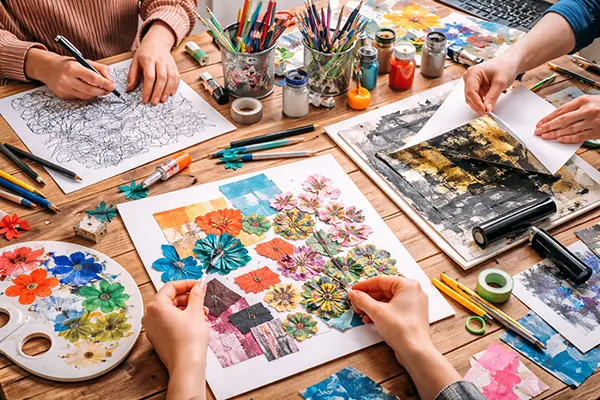
Collage is one of the most beginner-friendly methods. Start by choosing a theme that reflects your current state – “overload”, “calm”, “change”, or simply “today”. Cut out images, colours or words that resonate. Arrange them on paper before gluing. There is no correct composition; what matters is the act of choosing and placing.
Psychologically, collage works because it externalises inner experience. When stress feels abstract and unmanageable, turning it into visible fragments gives it form. Once something has form, it feels less chaotic and more containable.
Monotype printing involves applying paint to a smooth surface (such as a plastic sheet), placing paper on top and pressing gently to transfer the image. Each print is unique. The unpredictability is part of the therapeutic effect: you learn to accept outcomes you cannot fully control.
How to Approach Imperfection in These Techniques
In collage, uneven edges and overlapping layers are not flaws; they create texture. Instead of asking, “Is this good?”, ask, “Does this reflect something real for me?” That shift changes the evaluation from aesthetic judgement to personal meaning.
With monotype, the print may blur or smudge. Rather than correcting it immediately, observe it. What does the unexpected shape resemble? Often, the most interesting elements emerge from what initially appears to be a mistake.
Both methods gently train cognitive flexibility. Accepting irregular results in art can translate into greater tolerance for uncertainty in everyday life – a skill increasingly valued in high-pressure environments.
Technique Three, Four and Five: Linear Drawing and Structured Repetition
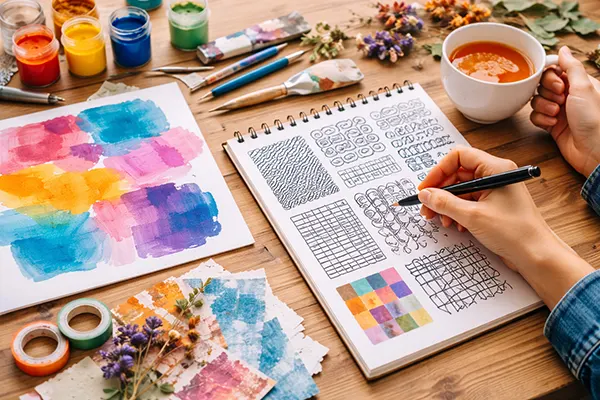
Linear drawing focuses on lines only – straight, curved, parallel or intersecting. Set a timer for 15 minutes and fill a page with continuous lines without lifting the pen. The rhythm of movement regulates breathing and slows racing thoughts.
Another variation is pattern repetition. Choose a simple motif – dots, waves, small squares – and repeat it across the page. This method resembles mindful doodling and has been shown to improve concentration and reduce agitation.
A fifth option is limited-colour abstraction. Select only two or three colours and create shapes without aiming to represent anything specific. Limitation reduces decision fatigue, which is a common stress trigger in 2026’s fast-paced, choice-saturated environment.
How to Evaluate Your Work Without Self-Criticism
Replace aesthetic judgement with reflective questions. Instead of “Is this beautiful?”, ask: “How did I feel while making it?” and “What changed in my body or mood?” Stress reduction is the primary indicator of success, not visual appeal.
Use a simple three-point reflection after each session: 1) My emotional state before; 2) My emotional state after; 3) One element I noticed. Writing these notes builds awareness of progress over time and grounds your evaluation in observable experience.
Finally, treat each piece as documentation rather than performance. You are recording a moment, not competing. When creativity becomes a private space for regulation rather than validation, it fulfils its true purpose: supporting mental balance in a sustainable, realistic way.