Analog Hobbies in 2026: Why People Are Returning to Film Photography, Vinyl Records and Paper Journals
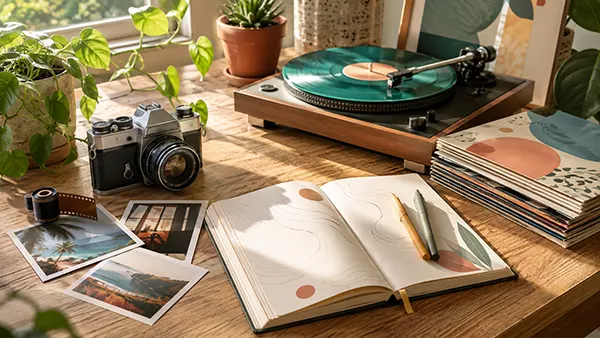
Film cameras that limit the number of photographs, records that require someone to turn over an album and notebooks that cannot send a notification may appear inconvenient beside modern digital tools. Yet in 2026, precisely those limitations have become part of their appeal. Film photography continues to attract new users, vinyl sales remain commercially significant, and paper journals have developed communities that include students, creative professionals and people simply looking for a more deliberate leisure routine. This is not a wholesale rejection of smartphones, streaming or cloud-based services. Most people who enjoy analogue hobbies still use digital technology every day. What has changed is the role of physical activities within that routine. A film camera makes each exposure a small decision. A record encourages listening to an album as a sequence rather than a collection of isolated tracks. A notebook keeps thoughts in one physical place without alerts, feeds or incoming messages. These qualities help explain why apparently old-fashioned formats have acquired a new relevance in 2026.
Why Analogue Hobbies Have Become Relevant Again in 2026
The renewed interest in analogue leisure is easier to understand when it is treated as a change in behaviour rather than a wave of simple nostalgia. Many of the people buying film cameras, records and carefully made notebooks did not grow up relying on these formats. For younger users, loading a roll of 35mm film or choosing an LP can therefore feel new rather than retrospective. The attraction often comes from doing one clearly defined activity at a time. Digital devices are highly efficient precisely because they combine communication, entertainment, shopping, work, photography and information in one place. That efficiency has obvious benefits, but it also means that an activity can be interrupted without warning. A physical hobby creates a clearer boundary. When someone is writing in a journal, there is no second function hidden inside the notebook. When a record is playing, the object itself does not offer a stream of unrelated recommendations. The limits are visible, predictable and easy to understand.
Current commercial evidence also shows that the interest is more substantial than a short-lived aesthetic trend. The latest complete figures available in 2026 show that UK vinyl revenue reached £174.4 million in 2025, according to the BPI, representing a 19.9% annual increase. In the United States, the RIAA reported more than $1 billion in vinyl revenue for 2025 and a 9.3% rise from the previous year. It was the nineteenth consecutive year of growth for the format. Those numbers matter because streaming remains the dominant way to access recorded music. Vinyl has not returned because listeners suddenly need physical records to hear songs. People are paying for an additional form of listening that offers artwork, ownership, collecting and a specific routine. The physical format performs a different job from a streaming subscription, which helps explain how both can remain useful to the same listener.
Film photography provides another useful example. Ricoh Imaging introduced the PENTAX 17 in 2024 through its Film Camera Project and continues to list the model in its current product range. The camera uses 35mm film but exposes a half-frame image, producing vertical photographs in its normal orientation. Its designers deliberately retained actions such as manually advancing the film. A major camera manufacturer developing a new film model decades after digital photography became standard does not prove that analogue cameras will regain their former mass-market position. It does demonstrate that a sufficiently active group of customers exists to justify new products rather than relying entirely on used cameras from the 1980s, 1990s and early 2000s. Film photography in 2026 is therefore better described as an established specialist hobby with a mixture of second-hand equipment, newly manufactured cameras, active processing services and continuing supplies of photographic film.
Limits, Rituals and Physical Objects Have Become Part of the Appeal
Analogue hobbies make small actions more noticeable. With film photography, the photographer chooses a frame knowing that the result cannot immediately be reviewed and deleted. There may be 24 or 36 exposures on a conventional roll, while half-frame cameras can make roughly twice as many images from the same length of film. Either way, the supply is finite. That changes the rhythm of taking photographs. It does not automatically produce better pictures, and digital photographers can work just as carefully, but film makes the cost and number of exposures more visible. Loading the camera, advancing the film and waiting for development separate taking a photograph from seeing the finished image. For some users, the delay is frustrating. For others, it is one of the main reasons to use film. The photographs arrive as a completed group rather than as another set of images competing for immediate attention on a phone.
Vinyl creates a similar sequence of deliberate actions. A listener chooses a record, removes it from its sleeve, places it on a turntable and normally listens for a substantial part of one side before turning it over. None of these steps makes analogue audio objectively more practical than instant digital playback. They do, however, turn listening into an activity with a beginning and an end. Album artwork and liner notes remain visible throughout the experience, while the record itself becomes part of a collection that occupies real space. This physical ownership is important because it is different from access. A streaming catalogue can contain millions of recordings, but an individual listener does not possess that catalogue. A shelf of 50 records is far smaller, yet every item has been selected and kept. For collectors, the limitation can make a personal music library easier to understand and more closely connected with particular memories.
Paper journals introduce an even simpler form of friction. Writing by hand is usually slower than typing, corrections are less tidy, and rearranging a finished page can be difficult. Yet those apparent disadvantages can support the purpose of the activity. A private notebook does not need the speed of office software. Slower writing may encourage the writer to choose what is worth recording rather than attempting to capture everything. Handwriting also leaves visible traces of the moment: changes in pressure, crossed-out words, margins, diagrams and additions made later. Research on handwriting suggests that writing movements engage the brain differently from keyboard input, although such findings should not be exaggerated into a claim that paper is universally better than screens. The more practical point is that handwriting is physically different. For people who spend much of the day typing and tapping, that difference alone can make a journal feel like leisure rather than another version of work.
Film Photography and Vinyl Offer Something Digital Media Does Not Need to Provide
Film photography survives partly because it produces a recognisable process as well as a recognisable image. Modern digital cameras and smartphones can imitate grain, faded colours and other characteristics associated with film, often very convincingly. What they cannot reproduce is the complete physical sequence of exposing light-sensitive material, finishing a roll, processing it and receiving negatives or scans. For enthusiasts, the process matters as much as the final appearance. Different films also respond differently to light, colour and contrast, which gives photographers practical choices before shooting rather than only during editing. This does not make film more authentic than digital photography. It simply gives the photographer another set of constraints. Someone taking family photographs, street scenes or travel pictures may enjoy working within those boundaries precisely because a phone normally makes photography almost unlimited.
Cost is an important part of any realistic discussion in 2026. Film photography is not a cheap replacement for phone photography. A photographer must buy film, and colour processing and high-resolution scanning can make regular use expensive. Used cameras also vary greatly in condition. Light seals, shutters, exposure meters and battery compartments may require servicing, while some electronic models depend on parts that are no longer manufactured. Newer cameras reduce some of that uncertainty but normally cost more at the beginning. Anyone starting the hobby is therefore better served by choosing a simple, tested camera and calculating the cost of several rolls and laboratory processing before purchasing additional lenses or accessories. The hobby becomes much easier to manage when film is treated as a limited leisure budget rather than an unlimited substitute for digital photography.
The same practical distinction applies to records. Vinyl provides physical ownership and a particular listening routine, but it also demands storage space and suitable equipment. Record players range from basic all-in-one units to separate turntables that require an amplifier and speakers, so costs can rise quickly when equipment becomes part of the collecting habit. Records themselves also need reasonable handling and storage because heat, pressure, dust and scratches can affect them. None of this is necessary when playing the same album through a streaming service. For that reason, a sensible vinyl collection is usually selective. Listeners may buy albums that have personal significance, releases with strong artwork, particular pressings or records they expect to play repeatedly. Streaming can remain the method for everyday sampling, while vinyl is reserved for music that the listener wants to own physically.
Imperfection and Scarcity Can Make Creative Decisions More Meaningful
One of the more interesting characteristics of analogue media is that small imperfections are accepted as part of normal use. Film can show grain, slight variations in exposure or colours influenced by the stock, processing and lighting conditions. Records can acquire faint surface noise. A notebook may contain uneven handwriting, ink marks and pages that would look untidy if reproduced in a carefully formatted document. These features would usually be treated as faults in digital files, where perfect duplication is expected. With physical media, they can act as evidence of use. This does not mean every defect is desirable. An underexposed negative, damaged record or leaking pen can simply be annoying. The difference is that analogue hobbies leave more room between technically perfect and completely unusable. People often learn to accept minor variations instead of correcting every detail.
Scarcity also affects decision-making. An unlimited camera roll makes it possible to take dozens of versions of almost the same image. A finite roll encourages the photographer to decide when a photograph is worth an exposure. A streaming account makes it possible to switch songs every few seconds, while putting on a record creates a mild incentive to let the album continue. A note-taking app can hold an effectively unlimited quantity of information, whereas a paper journal has a fixed number of pages. These constraints do not need to become strict rules. Their value lies in making choices visible. The photographer sees the frame counter. The record listener sees the side reaching its end. The journal writer sees the notebook gradually filling. Progress becomes connected with a physical object rather than an abstract total stored somewhere in an account.
This helps explain why analogue hobbies can remain satisfying even when their outputs are later digitised. Film photographers commonly receive scans and share selected photographs online. Record collectors may use streaming while travelling and play physical albums at home. Journal users may keep appointments in a digital calendar while using paper for reflection, sketches or weekly planning. The analogue component does not have to remain isolated from modern technology to retain its purpose. In fact, combining the two can remove many traditional inconveniences. A photographer can keep negatives while using scans for easy sharing. A music listener can sample an unfamiliar album digitally before deciding whether it deserves space on a shelf. A journal writer can use electronic reminders for time-sensitive tasks while keeping longer thoughts on paper. The physical format is then chosen where its limitations are useful rather than imposed everywhere.
Paper Journals Are Becoming a Practical Offline Routine
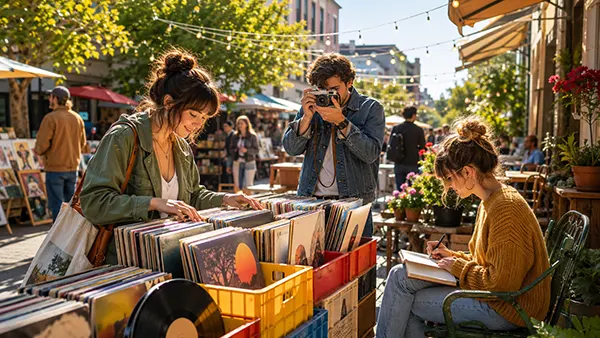
Paper journalling covers far more than writing a traditional diary at the end of each day. Current users employ notebooks for weekly planning, reading notes, travel records, habit tracking, sketches, personal archives and combinations of several systems. A 2025 ACM study on analogue journalling described practices shaped by materials, personal circumstances and communities, with participants adapting their notebooks to different goals rather than following one fixed method. That flexibility is important. A journal can be highly organised or almost completely informal. Some people use dated planners with predefined spaces; others prefer blank notebooks where each page develops differently. The absence of a required method lowers the barrier to entry because the hobby can begin with an ordinary notebook and pen. Expensive stationery may be enjoyable, but it is not necessary for the basic activity.
For planning, paper works particularly well when the number of priorities is small enough to fit visibly on a page. A weekly spread can show appointments, several important tasks and a short record of completed work without hiding information behind menus or separate screens. The physical limit can discourage the habit of creating enormous task lists that are impossible to finish. At the same time, paper is weaker when information changes constantly. Repeated meetings, shared schedules, automatic reminders and collaborative projects are usually easier to manage digitally. In 2026, a useful paper routine therefore does not require moving every organisational task into a notebook. Many people can benefit more from assigning different jobs to different tools: a digital calendar for fixed appointments, for example, and a notebook for priorities, ideas and reflection.
Journalling also appeals because the record becomes more personal over time. A finished notebook contains not just information but evidence of when and how it was used. Tickets can be attached to travel pages, a quick diagram can sit beside a written thought, and several months of handwriting can show changes that are difficult to notice from isolated digital entries. The result is a physical archive that can be opened without searching for a file name, remembering a password or depending on a particular application. Privacy still requires common sense: a notebook can be lost, read by another person or damaged, so it is not automatically more secure than encrypted digital storage. Its advantage is simpler. The owner understands exactly where the information is stored. For private reflections that do not need search functions, syncing or sharing, this simplicity can be useful.
Analogue Leisure Works Best Alongside Modern Technology, Not Against It
The strongest version of the analogue revival is not based on pretending that older formats are universally superior. Digital photography is faster, cheaper per image and more flexible. Streaming makes an enormous music catalogue accessible without requiring shelves of physical media. Digital calendars can update appointments instantly across several devices. These advantages are why the newer tools became dominant in the first place. Analogue hobbies succeed when they are chosen for tasks in which efficiency is not the only objective. Leisure can benefit from repetition, anticipation and physical involvement even when those qualities would be irritating during urgent work. Developing a roll several days after taking the photographs would be unacceptable for breaking news, yet it can be enjoyable for a personal weekend project. Turning a record over halfway through an album is unnecessary, but during an evening at home it can be a welcome interruption.
People considering one of these hobbies in 2026 can therefore start more effectively by choosing a specific use rather than purchasing an entire collection at once. A person interested in film might begin with one tested camera and a few rolls. A new vinyl listener can choose several favourite albums before deciding whether collecting is genuinely enjoyable. Someone interested in paper journalling can use a basic notebook for a month before buying specialist planners, fountain pens or decorative materials. This approach keeps the activity focused on use rather than acquisition. Analogue hobbies are particularly vulnerable to becoming shopping hobbies because cameras, records and stationery are attractive physical products. Buying equipment can feel like progress even when little photography, listening or writing actually occurs. A smaller starting point makes it easier to learn which parts of the activity provide lasting satisfaction.
There are also environmental and financial reasons to avoid treating physical hobbies as an excuse for constant consumption. Vinyl records use materials, film requires manufacturing and chemical processing, and notebooks require paper and transport. Keeping equipment for longer, buying used cameras or records when appropriate, maintaining a modest collection and actually finishing notebooks are more consistent with the slower values that attract people to these activities in the first place. A well-used camera, a shelf of records that are regularly played or several completed journals can provide years of value without requiring continuous purchases. The appeal of analogue leisure is therefore not really about owning more things. At its most practical, it is about giving a small number of objects a clear role in everyday life.
That distinction is likely to keep film photography, vinyl and paper journalling relevant beyond a single trend cycle. None of the three needs to defeat its digital equivalent to survive. Their purpose is narrower and, in many cases, more personal. A roll of film can turn an ordinary walk into a small photographic project. A record can make listening to one album the main activity rather than background audio. A notebook can hold twenty quiet minutes of writing without introducing another source of notifications. The common feature is not nostalgia but attention: each hobby creates a reason to stay with one process long enough for it to feel complete. In 2026, when convenience is available almost everywhere, choosing a slower method can itself become a meaningful form of leisure.