Creating Miniature Worlds: How Terrariums, Dioramas and Mini Gardens Became Creative Hobbies
A forest growing inside a glass jar, a tiny railway station surrounded by handmade buildings or a miniature cottage nestled among flowering plants can turn an ordinary shelf into an entire landscape. Creating miniature worlds has become a distinctive form of creative leisure, combining gardening, model-making, storytelling and decorative crafts. Terrariums, dioramas and mini gardens offer different ways to reproduce familiar places or invent imaginary settings on a small scale. Some enthusiasts enjoy recreating historical scenes with carefully measured details, while others prefer designing living landscapes that gradually change as plants grow. These activities require neither a large workshop nor extensive artistic experience. With suitable materials, patience and a little planning, even a modest tabletop can become a place for developing original three-dimensional compositions.
How Miniature Worlds Developed into a Creative Hobby
The fascination with miniature environments existed long before modern craft shops began selling ready-made kits. People have created small representations of buildings, gardens and everyday life for centuries, using them for decoration, education, religious purposes and entertainment. Architectural models helped demonstrate construction ideas, while detailed scenes became valuable tools for museums and historical exhibitions. Miniature furniture and doll’s houses also encouraged craftspeople to reproduce ordinary objects at remarkably small sizes. Over time, these traditions influenced recreational model-making, giving enthusiasts opportunities to create detailed environments without needing professional artistic training.
Terrariums have a particularly interesting history. During the nineteenth century, British physician Nathaniel Bagshaw Ward observed that plants could survive inside enclosed glass containers, an idea that contributed to the development of the Wardian case. These protective containers were subsequently used to transport living specimens over long distances and became fashionable indoor gardening features. Modern terrariums retain the same basic principle of maintaining suitable growing conditions within a confined space, although their purpose is usually decorative or recreational. Their appeal lies partly in the relationship between living vegetation and carefully arranged stones, soil, wood and other natural materials.
Dioramas followed a different path, developing through visual entertainment, exhibitions and educational displays before becoming established among model-making enthusiasts. Unlike living terrariums, they generally rely on artificial scenery to capture a particular moment, location or story. A modeller might reconstruct a Victorian street, a countryside railway crossing or a fictional settlement. Mini gardens occupy a position between these approaches, combining horticulture with decorative arrangements that suggest full-sized landscapes. Today, all three activities attract people interested in practical craftsmanship, interior decoration and creative projects that can be completed gradually at home.
Why Small-Scale Creativity Appeals to Different Generations
One of the attractions of miniature-making is the freedom to choose how much time, money and effort to invest. A simple composition may take an afternoon, while a detailed architectural scene can develop over several weeks. Beginners can work with recycled containers, inexpensive modelling materials and plants already available at home. More experienced enthusiasts may experiment with specialist paints, miniature lighting, handcrafted figures and intricate scenery. There is no requirement to follow a single artistic style. A realistic landscape, a whimsical fairy garden and an abstract arrangement of moss and stones can all be successful when their materials and proportions suit the intended design.
The process also provides a satisfying alternative to leisure activities centred entirely on screens. Measuring, cutting, planting, painting and arranging objects involve direct interaction with materials, while the finished composition offers something tangible to display. These tasks encourage concentration because even small adjustments can noticeably change the appearance of a scene. However, miniature-making is not necessarily a quick or effortless way to relax. Detailed painting requires patience, living plants need suitable care, and complex constructions sometimes involve repeated attempts. For many hobbyists, solving these practical difficulties becomes part of the enjoyment rather than an obstacle.
Another reason for the hobby’s accessibility is its connection with existing interests. Gardeners can experiment with miniature planting arrangements during colder months, railway enthusiasts can construct scenery for model trains, and history lovers can recreate buildings from particular periods. Families may enjoy assembling simple projects together, provided sharp tools, adhesives and small components are handled appropriately. Online craft communities, exhibitions and workshops also make it easier to exchange ideas and learn techniques. By 2026, miniature environments remain a versatile hobby because their basic methods can be adapted to different budgets, available spaces and levels of experience.
Terrariums and Mini Gardens: Creating Living Landscapes
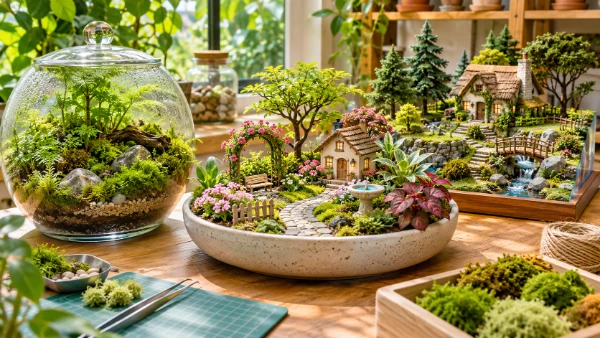
Terrariums are among the most accessible ways to combine creativity with indoor gardening. They use transparent containers to display small plants alongside natural decorative elements, allowing viewers to observe both the vegetation and the surrounding landscape. The most important distinction is between closed and open designs. A closed terrarium retains much of its internal humidity and suits plants that prefer consistently moist conditions. An open arrangement allows greater air circulation and is generally more appropriate for species that dislike prolonged humidity. Understanding this difference before selecting plants is essential, as an attractive composition will not remain healthy if its inhabitants require incompatible growing conditions.
For an enclosed tropical arrangement, suitable choices include fittonia, compact peperomia varieties, selected small ferns and appropriately sourced mosses. These plants can produce contrasting leaf colours, textures and heights without demanding excessive space. Open containers offer opportunities to use small succulents, provided they receive enough light and are planted in a freely draining growing medium. Combining moisture-loving moss with desert succulents in a sealed jar is a common beginner’s mistake because their watering requirements differ considerably. It is also worth checking the mature size of every plant. A specimen that appears perfectly proportioned at the beginning may eventually crowd neighbouring vegetation or press against the glass.
Building a terrarium begins with selecting a clean container that provides sufficient room for roots and future growth. A wide opening makes planting easier, particularly when positioning stones and delicate foliage. A layer of washed gravel or expanded clay can create space below the growing medium for excess moisture, although it cannot remove water from a container without drainage holes. Suitable peat-free compost should then be added, with horticultural grit where additional drainage is required. Larger decorative elements are best positioned before planting, followed by smaller stones and moss. Water should be introduced sparingly, since excess moisture is difficult to remove once the arrangement has been completed.
Designing and Maintaining a Miniature Garden at Home
Mini gardens provide greater freedom in their choice of containers and decorative features. Shallow ceramic bowls, wooden planters with suitable liners and outdoor troughs can accommodate small landscapes with pathways, miniature furniture and carefully positioned vegetation. For a cottage-garden appearance, low-growing thyme, compact sedums or other suitable small plants can be arranged around a miniature bench or stepping-stone path. Plant selection should reflect the actual location of the display, particularly its exposure to sunlight, rainfall and seasonal temperature changes. Outdoor arrangements also need proper drainage, while indoor projects must be protected against water damage to surrounding furniture.
A convincing landscape depends on composition rather than the quantity of ornaments. Start by deciding where the viewer’s attention should fall, perhaps on a small house, a winding path or an unusual stone. Place taller plants towards the rear or to one side, leaving visible space around the main feature. Fine gravel can suggest a walkway, while slightly larger rocks create the impression of natural outcrops. Repeating a limited selection of colours and materials helps different components appear connected. Scale matters too: an oversized miniature chair placed beside a tiny doorway can make an otherwise carefully arranged scene look inconsistent. Testing the layout before fixing decorations permanently makes later adjustments considerably easier.
Maintenance is particularly important when working with living compositions. Closed terrariums normally need bright, indirect light rather than strong sunshine, which can cause the enclosed container to overheat. Persistent heavy condensation may indicate excessive moisture, while a consistently dry interior can signal that watering is required. Dead leaves should be removed promptly to reduce the risk of decay and mould. Open succulent arrangements generally need more ventilation and a different watering routine. Mini gardens may also require occasional pruning, replacement of plants that become too large and cleaning of decorative elements. Rather than remaining completely unchanged, a living miniature landscape develops over time, making regular observation part of the creative process.
Dioramas and Model Scenery: Building Stories in Miniature
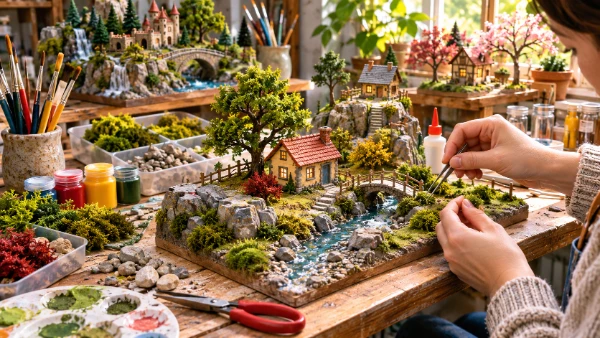
Dioramas differ from planted miniature gardens because their principal purpose is to represent a scene rather than maintain living vegetation. They can depict almost any subject, including a quiet village square, an abandoned industrial building, a woodland campsite or a moment from a historical event. Some are designed as independent display pieces, while others provide scenery for model railways, tabletop games or miniature collections. Their success depends on creating a believable relationship between objects, surfaces and surrounding space. Even a relatively simple scene can suggest a much larger environment when its layout gives viewers enough visual information to imagine what exists beyond the edges.
Scale is one of the first decisions a modeller must make. Common modelling ratios include 1:35, often used for military subjects, 1:72 for smaller historical models and 1:87 for HO-scale railways. At 1:35, an object measuring 175 centimetres in real life would be represented by a model approximately five centimetres tall. Consistent proportions help buildings, vehicles, furniture and figures belong to the same environment. However, exact mathematical accuracy is not essential for every decorative project. Fantasy scenes and stylised miniature interiors can use exaggerated proportions deliberately, provided the result follows a recognisable visual approach.
Many dioramas can be built using ordinary craft supplies. Cardboard, foam board, lightweight modelling foam and thin wood are useful for constructing buildings and terrain. Air-drying clay can form stone walls, uneven ground or decorative objects, while acrylic paints help reproduce brickwork, timber and weathered surfaces. Fine sand, commercially prepared modelling foliage and textured pastes can imitate soil or grass. A firm base is important because scenery may crack or bend if its support is too flexible. When cutting materials, use suitable protective equipment and ventilation, and choose adhesives compatible with the surface being joined. Solvent-based products and heated cutting tools require particular care and are not appropriate for unsupervised children’s projects.
Planning Your First Diorama and Developing Creative Skills
A manageable first project might depict a woodland footpath with a small fence, a stone wall or a bench. Beginning with a limited scene makes it easier to practise the main techniques without becoming overwhelmed by complicated construction. Sketch the arrangement from above and mark where the principal objects will stand. Build the larger structures first, then shape the ground around them. Once the base is secure, apply paint in thin layers and allow it to dry before adding surface textures. Small details such as fallen leaves, worn paving stones or subtle changes in ground colour can then be introduced. These elements help establish atmosphere, but adding too many can distract from the central subject.
Lighting and perspective offer further possibilities as confidence develops. A miniature street scene may benefit from a warm light inside a shop window, while a woodland arrangement can use darker tones beneath trees to suggest shade. Battery-powered miniature LEDs can create convincing effects, provided their wiring and power supply are installed safely. Forced perspective is another useful technique: placing smaller objects towards the background can make a shallow composition appear deeper. Photographs taken at the approximate eye level of miniature figures are especially helpful for identifying unrealistic gaps, oversized textures or awkward proportions. They also provide a record of the construction process and make it easier to compare different design choices.
The greatest long-term appeal of creating miniature worlds is the opportunity to combine several practical skills within a single hobby. A terrarium introduces plant care and natural composition, a mini garden encourages experimentation with seasonal growth and decoration, and a diorama develops an understanding of materials, proportions and visual storytelling. These interests can overlap: a modeller may incorporate carefully preserved natural materials into artificial scenery, while a gardener may make miniature buildings to accompany a planted arrangement. Starting with one small, well-planned project is usually more rewarding than purchasing an extensive collection of supplies immediately. As experience grows, the techniques learned from each finished scene can be applied to more ambitious ideas, making miniature-making a creative pursuit with considerable room for personal development.